
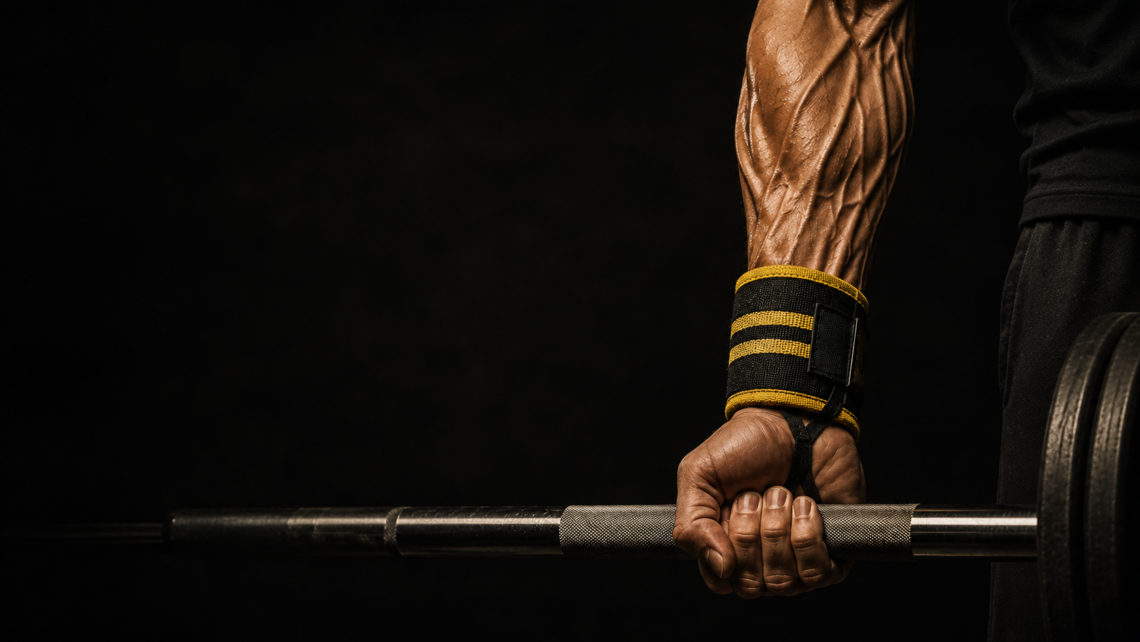
Look down at your wrist mid-lift and you’ll realize something most people never think about: it’s doing all the work. Every barbell curl, every push-up, every heavy pull — your wrist is the hinge holding it all together. And if that hinge is weak, everything built on top of it suffers.
Here’s the good news. You don’t need hours in the gym to fix that. Just 10 focused minutes a day, done consistently for two weeks, is enough to start building real wrist strength — and the payoff shows up everywhere from your lifts to your everyday grip.
Why stronger wrists matter more than you think
Strong wrists aren’t just about looking tough in a wrist wrap. They’re the foundation for how safely and effectively you train. Weak, unstable wrists put extra strain on the small stabilizing muscles and tendons every time you grip a bar, plank, or push through a rep. Over time, that strain adds up — and it’s often what leads to nagging wrist pain that never seems to fully go away.
Train your wrists on purpose, though, and three things start to shift:
1. You prevent injuries
Stronger wrists mean less risk of pain and strain during training. When the muscles and tendons around your wrist joint are conditioned to handle load, they’re far less likely to buckle under a heavy set or an awkward angle.
2. You improve performance
A stable wrist translates directly into better lifts. Whether it’s a heavy deadlift, a strict push-up, or a barbell curl, your grip strength and overall control improve when your wrist isn’t the weak link.
3. You build bigger forearms
Wrist training and forearm growth go hand in hand. Strengthening your wrists activates and develops the surrounding forearm muscles, supporting thicker, more powerful-looking forearms over time.
The 10-minute daily wrist routine
You don’t need a gym full of equipment — just a light pair of dumbbells or a resistance band, and a few minutes.
- Wrist curls — Rest your forearm on your leg or a bench, palm up, and curl a light dumbbell upward. 2 sets of 12–15 reps.
- Reverse wrist curls — Same position, palm facing down. Targets the top of the forearm and wrist extensors. 2 sets of 12–15 reps.
- Wrist rotations — Slowly rotate your wrist in circles while holding a light weight or just your fist. 30 seconds each direction.
- Grip squeezes — Squeeze a stress ball or grip trainer hard for 3–5 seconds, then release. 2 sets of 15 reps.
- Farmer’s holds — Grab a moderately heavy dumbbell in each hand and hold at your sides. 2 rounds of 20–30 seconds.
Keep the weights light and the movements controlled. This routine builds a foundation — it’s not about how heavy you can go on day one.
Can two weeks really make a difference?
Two weeks is enough time to build a real habit and notice early changes — steadier grip, less wrist shakiness during pushing or pulling movements, and better control on your lifts. That’s genuine, worthwhile progress.
What two weeks generally won’t do is deliver dramatic size or strength gains. That kind of change builds over months of consistent effort. Think of this routine as your launchpad — a way to build the habit now so the bigger results have something to grow from later.
Tips to get the most out of it
- Progress slowly. Increase weight or hold time only once the current level starts to feel easy.
- Prioritize control over speed. Slow, deliberate reps recruit your muscles far more effectively than fast, sloppy ones.
- Show up daily. Ten minutes a day beats one long session a week, every time.
- Listen to your wrists. If something feels sharp or painful (not just fatigued), scale back.
Frequently asked questions
How often should I train my wrists? Most people can safely train wrists 4–6 days a week, since the sessions are short and low-fatigue.
Will wrist exercises really prevent injuries? Yes — building strength and stability around the wrist joint reduces the strain that typically leads to overuse injuries.
How long until I see results? Expect early improvements in control and endurance within 2 weeks, with more noticeable strength and size gains building over 6–8 weeks of consistent training.
Final thoughts
Consistency today, strength tomorrow. Stronger wrists don’t require a complicated program — just 10 committed minutes a day. Stay focused, keep pushing, and give your body the two weeks it needs to build the habit. The strength will follow.
Tags: stronger wrists, wrist strengthening exercises, grip strength, wrist workout, prevent wrist injuries, bigger forearms, wrist exercises for strength, improve grip strength